A Community-Based Family-Focused Experiential Learning Intervention to Improve Micronutrient Status and Maternal-Infant Outcomes Among Rural Antenatal Women in India: Study Protocol for a Randomized Controlled trial
DOI:
https://doi.org/10.5530/ctbp.2025.4s.24Keywords:
Micronutrients, pregnant women, infants, family focused experiential learning interventionAbstract
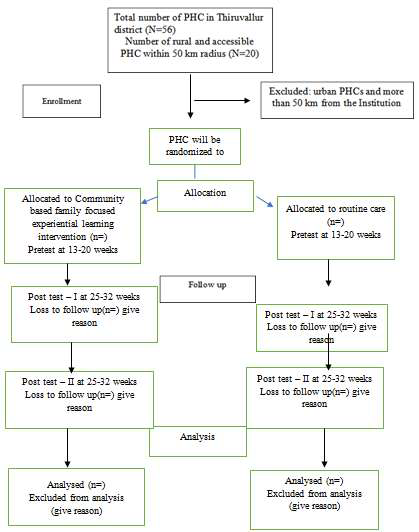
Background: Micronutrient deficiency, a global issue, especially affects pregnant women and children, leading to health problems(1–3). The issue is more severe in low-income countries due to poor diets, causing multiple deficiencies (4). During pregnancy, meeting nutritional needs like iron, calcium, and vitamin D through diet alone is challenging (3). In India, low intake of these nutrients contributes to anemia and vitamin D deficiency. We aim to determine the effectiveness of community-based familyfocused experiential learning intervention to improve micronutrients, maternal and infant outcomes. Methods: A parallel-group, twoarm randomized controlled trial of a community-based, complex intervention in rural India aims to decrease micronutrient deficiency, including anemia, calcium, and vitamin D deficiency. The primary outcomes are defined as hemoglobin < 11 g/dL, serum calcium < 8.6 mg/dL, and 25(OH)D ≤ 20 ng/mL, which will be assessed using biochemical methods. Secondary outcomes, including maternal behavioral changes, infant growth, and development, will be assessed using questionnaires in the third trimester and six months after delivery. The Primary Health Center (PHC) is the unit of randomization. Twenty PHCs in Thiruvallur district, Tamil Nadu, will be randomized in a 1:1 ratio based on inclusion criteria.The intervention comprises two phases. Phase I will be conducted in the PHC and will include teaching and discussion, food plate counseling, a food selection workshop, and a cooking demonstration on a group basis, with handouts on micronutrients provided. Phase II will take place at home and will consist of a home visit featuring a modified Paramapadham mini flash card game and a cooking demonstration, along with micronutrient handouts to reinforce learning. For the control group, only routine care will be provided by healthcare professionals at the PHCs. Discussion: Engaging rural antenatal women in reducing micronutrient deficiencies (iron, calcium, and vitamin D) remains a challenge and is often a missed opportunity for prevention. The community-based, familyfocused experiential learning intervention primarily targets these deficiencies and aims to bridge evidence gaps on utilizing pregnancy as a key period to improve micronutrient status. If successful, this approach could significantly enhance the health of women in resource-limited settings worldwide. Trial registration: Clinical Trial Registry, REF/2022/06/055817 N