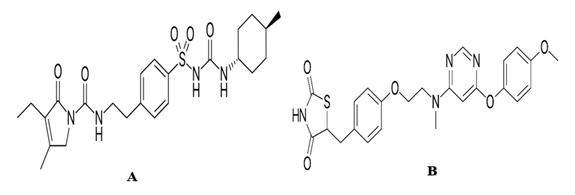
Development and Validation of a Stability-Indicating RP-UPLC Method for the Simultaneous Determination of Glimepiride and Lobeglitazone Sulfate in Pharmaceutical Dosage Forms
DOI:
https://doi.org/10.5530/ctbp.2026.4.44Keywords:
Forced degradation, Glimepiride, Lobeglitazone sulfate, Method validation, RP-UPLC, Stability-indicating methodAbstract
A simple and rapid RP-UPLC method was developed and validated for the simultaneous analysis of Glimepiride (GLM) and Lobeglitazone sulfate (LBZ) in pharmaceutical formulations. Chromatographic separation was performed on a Phenyl column using a mobile phase of 0.1% formic acid and acetonitrile (70:30, v/v) at 0.5 mL min⁻¹, with detection at 266 nm. Retention times were 1.267 min for GLM and 1.876 min for LBZ. Linearity was achieved over 25–150 μg/mL for GLM and 12.5–75 μg/ mL for LBZ (R² = 0.99956 and 0.99980, respectively). Recoveries ranged from 99.8–100.3% (GLM) and 99.3–100.1% (LBZ), with method precision (%RSD) below 0.64% and LOD/LOQ values of 0.6/2.0 μg/mL (GLM) and 0.3/1.0 μg/ mL (LBZ). Stress degradation studies established its stability-indicating capability, with peroxide treatment producing the highest degradation (15.9% for GLM and 16.5% for LBZ). Peak purity analysis demonstrated that analyte peaks remained free from interference by degradation products, indicating the validated method is reliable for routine quality assessment and stability evaluation of Glimepiride and Lobeglitazone sulfate in formulations.