Non-Coding RNA Regulators of the Immunosuppressive Tumour Microenvironment in Glioma: a Cross-Cohort TCGA Analysis Identifying Delivery-Aware Therapeutic Targets
DOI:
https://doi.org/10.5530/ctbp.2026.4.52Keywords:
glioma, tumour microenvironment, long non-coding RNA, tumour-associated macrophages, competing endogenous RNA, bloodbrain barrier deliveryAbstract
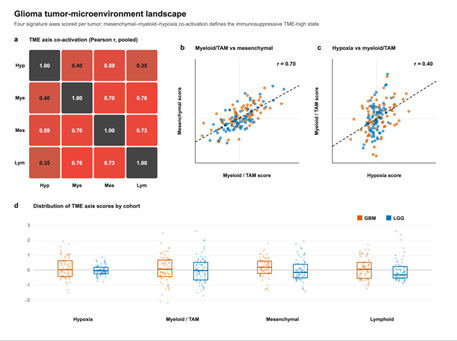
Gliomas are the most common malignant primary brain tumours, and their dismal prognosis is driven in large part by an immunosuppressive tumour microenvironment (TME) dominated by tumour-associated macrophages and microglia, hypoxia and mesenchymal transition. The non-coding RNA (ncRNA) circuitry that couples these programmes remains incompletely defined, and few candidate regulators have been evaluated for therapeutic tractability given the blood-brain barrier (BBB). Here we integrated transcriptomic and clinical data from TCGA-GBM and TCGA-LGG to map ncRNA regulators of the glioma TME and to prioritise delivery-aware targets. Tumours were scored along four TME axes (hypoxia, myeloid/TAM, mesenchymal and lymphoid), and long non-coding RNAs (lncRNAs) and microRNAs (miRNAs) were tested for differential expression, axis correlation, survival association and competing- endogenous-RNA (ceRNA) connectivity. Across 304 GBM and 533 LGG scored tumours, the myeloid, mesenchymal and hypoxia axes were strongly co-activated, defining a TME-high state. A replicated module of lncRNAs (including LINC02381, PRKAR1B-AS1 and LBX2- AS1) and the miRNAs miR-155 and miR-23a was up-regulated in TME-high tumours, with Spearman correlations reaching rho = 0.70 and concordant effects between cohorts. High expression of these ncRNAs was associated with shorter overall survival (median hazard ratios 1.5-2.2; best P < 1e-20). Expression-supported ceRNA reconstruction placed LINC02381 as a hub linking miR-155 and miR-23a and de-repressing target genes enriched for Notch signalling (DLL1). Integrating replication, effect size, survival and network evidence yielded a 50-target, BBB-aware, delivery-aware shortlist mapped to the TAM/microglia and hypoxic-necrotic compartments. These candidates provide a prioritised, experimentally testable basis for antisense, RNA-interference and antagomir strategies against the glioma TME.