Multi-Omic Integration Reveals a Lung Adenocarcinoma-Specific Tumour-Suppressor Survival Axis Where High-Dimensional Prediction Fails
DOI:
https://doi.org/10.5530/ctbp.2026.4.51Keywords:
lung adenocarcinoma, multi-omic integration, survival analysis, tumour-suppressor genes, metabolic reprogramming, machine learningAbstract
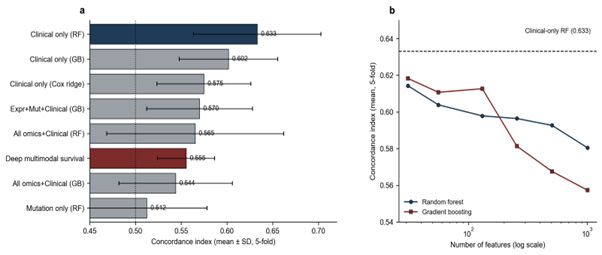
Multi-omic profiling is widely expected to improve cancer survival prediction, yet rigorous, transparent comparisons against simple clinical baselines remain scarce. We assembled a seven-modality matrix (gene expression, DNA methylation, somatic mutation, copy-number variation, reverse-phase protein array, clinical variables and protein-interaction context) for 628 patients with lung adenocarcinoma (LUAD) and 497 patients with lung squamous cell carcinoma (LUSC) from The Cancer Genome Atlas. A multimodal variational-autoencoder survival network and a panel of classical machine-learning models were trained and compared for overall- survival discrimination. Deep multimodal survival learning achieved a mean cross-validated concordance index (C-index) of 0.555, whereas a clinical-only random forest attained 0.633; adding high-dimensional omics consistently reduced performance, with the all-feature configuration falling to 0.593. Modality-ablation and nested cross-validation confirmed that this gap reflects the sample-to-feature regime (628 samples versus 1,902 features) rather than model choice. We therefore repurposed the omic data for biological discovery. A six-gene tumour-suppressor panel (KEAP1, STK11, TP53, SMARCA4, NF1 and CDKN2A) added independent prognostic information in LUAD (panel-plus-clinical C-index 0.602; panel hazard ratio 1.16, p = 0.025) but did not validate in LUSC (hazard ratio 0.94, p = 0.48), indicating histology-specific biology. STK11 mutation was the strongest single-gene signal (log-rank p = 0.044). Highrisk LUAD tumours showed coordinated up-regulation of cancer-testis antigens (MAGEA family, PRAME; p < 10^-14), enrichment of lipid and steroid metabolism (p = 0.011) and extracellular- matrix degradation (p = 0.032), together with reduced KEAP1 protein (p = 0.001). Panel-gene recurrence was confirmed across seven independent cBioPortal lung cohorts. These results demonstrate that multi-omic data can yield coherent, mechanistically interpretable biology even when they fail to improve prediction, and define a LUAD-specific metabolic-aggressive survival axis with therapeutic implications.